One deliciously apt typo to start from London South, page 506, where Kew Gardens is said to have developed from the Old Dear Park in Richmond
East Barsham manor house, Norfolk : the royal arms over the porch on the main house seem stone not brick.
.JPG)
Cawston church, Norfolk: there are three figures on the hammerbeams that have been thought to be from a mediaeval rood; Pevsner comes to no conclusion. However, my images show that two are probably Victorian, that one of these is obviously St.Agnes, the patron saint of the church, holding a palm and a lamb, and that the third figure is a mediaeval female with original paint remaining on her dress.
+(465x800).jpg) |
| c19 st.agnes with lamb, not the angel of the annunciation or st.john. |
+(528x800).jpg) |
| c15 female, poss. st.mary? |
+(660x800).jpg) |
| c19 male, prob. an apostle |
Salle church, Norfolk; there's a funerary helmet hanging in the north transept not in Pevsner, looking C16 to me.
+(800x791).jpg)
Weybread church, Suffolk. Pevsner gives most of the round tower a Norman date, but I reckon C14th, as the flints around the windows are undisturbed, and they and the putlog holes are lined with mediaeval brick. There is also a little C14 chequer work around the base.
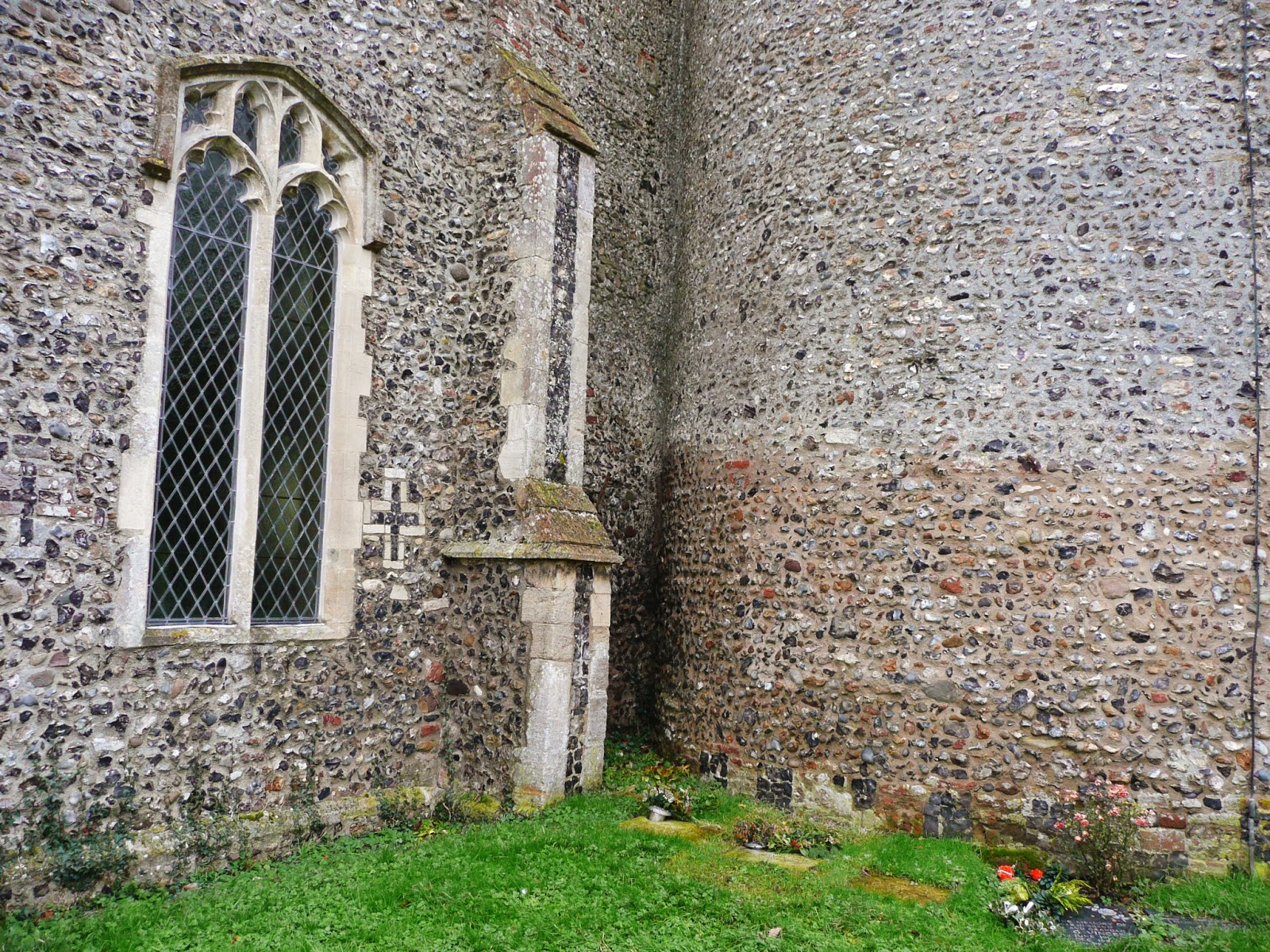 |
| Squares of flint and stone along the base of the tower |
 |
| Mediaeval brick edges of putlog holes and lights |
Shilton church, Oxfordshire; Pevsner says that the font shows the passion with apostles on each corner, missing Christ in judgement on one side, with angels blowing the last trump on each corner, with two others holding symbols of the passion: nails, crown of thorns and cross. I would argue with his description of this as rustic work too, but that's a value judgement, and neither here nor there. Even if I'm right.
 |
| Christ showing his wounds at the last judgement |
 |
| Last trump blowing angel |
Wordwell church, Suffolk; Pevsner claims that the figures carved on the tympanum of the north door are pagan, whereas I'd say they are early Norman work of C1100; the left hand figure seems to be in the orans position indicating prayer or wonder, whilst the other could be holding a representation of the host. I've no explanation of the marks carved in between, as they look to be purposeful rather than filler. A similar figure to the two on the tympanum can be seen on the obviously Norman capital on the south door.
 |
| Norman capital |
 |
| The tympanum in question |

The superb marble and mahogany gents' lavatories under Wesley's Chapel on City Road should get a mention too, well worth a visit.

 All Saints church Kingston on Thames has 4 unmentioned C16 stained glass roundels. Here are two.(Incidentally, the Saxon foundations that are mentioned in Pevsner are no longer visible)


Great Bardfield, Essex, has a C12 Norman pillar piscina kicking around loose in the porch that Pevsner doesn't mention.


Felsted Essex font bowl is more like late C13 than Norman as given in the B.of E.
 Colchester now, the arcades of StMary at the walls are obviously terracotta, not intricately carved stonework as the B.of E. claims.

 Also at Colchester this heraldic glass on the landing of the town hall is not Clayton and Bell like others here, but 50 years older and looks like it came from the earlier building.
 Brome church, Suffolk was barely glimpsed at by Pevsner, as he missed the Perp porch on the south side of the building, and of the superb stained glass by Heaton, Butler and Bayne he merely says 1860s . (Pretty sure this will be sorted in the new one soon, but you never know)


 |
| last judgement detail from east window by robert turnhill bayne |
 |
| C15 porch |

.JPG)
.JPG)
.JPG)
.JPG)
.JPG)
.JPG)
And there's this Italianate Victoria Park Baptist chapel on Grove Road in Bow, east London, could do with a name check....
.JPG)
And this Deco factory in Theydon Road , Clapton built in the 1930s by Sir Owen Williams missed out too. There were many such scattered around Hackney until about 15 years ago; if Pevsner had named them, they may still have existed.
.JPG)
.JPG)
London's Archway Road has an unlisted tube ventilator and electricity station worth a mention too, being probably by Holden.


 At Harrowden Hall in Northants the prof. and everyone else failed to recognise the bronze angels from Cardinal Wolsey's tomb sitting on the gateposts, including them in a job lot described as late C16th lead statuary, but since they were probably covered in paint at the time and are less than exciting pieces anyway I think he was hardly to blame for that. The slots which took the missing wings may have been plastered over, or not obvious from the ground, and he could hardly have gone around sticking a blade into objects just to see what they were made of, so his mistake here was excusable.
They've gone to the V+A now valued at 5 million pounds, see related blog.
%2B(756x800).jpg) Great Bedwyn in Wilts. had a mason's yard opposite the church which became a sort of museum over the years, with examples of lapidary art affixed to the walls and a yard full of carved odds and ends, including many georgian gravestones, victorian church art and even a stone biplane. much has gone over the years, but many of the painted tombstones remained on the front and side of what became the post office for a while. Pevsner didn't mention them at all, which is odd, as you'd be hard pressed to miss them. Many are nicely painted, as many tombstones once were.
Great Bedwyn in Wilts. had a mason's yard opposite the church which became a sort of museum over the years, with examples of lapidary art affixed to the walls and a yard full of carved odds and ends, including many georgian gravestones, victorian church art and even a stone biplane. much has gone over the years, but many of the painted tombstones remained on the front and side of what became the post office for a while. Pevsner didn't mention them at all, which is odd, as you'd be hard pressed to miss them. Many are nicely painted, as many tombstones once were.%2B(800x600).jpg)
Westminster abbey cloister has this seemingly C13 statue of Christ, the sort of thing designed for a gable. No one mentions it, and there's no obvious empty niche extant, so I've no idea where it's from. It doesn't look like some war damaged Victorian bit to me, but bo one there seemed to know any history.


.JPG)
.JPG)
.JPG)
.JPG)


.JPG)